We were hitting speeds in the high sixes going upwind with 25 knots of wind and big seas and the ride was pretty bad. It would be nice to slow down but Wings, sailing to windward in a strong breeze, doesn’t know slow. Puttin up a small headsail and putting in a reef in the main makes no difference; still too fast. We flew off of wave after wave and landing was like hitting concrete. The noise was deafening. The bow tossed up ocean water like someone throwing buckets, only lots more. The wind then carried it back and it landed on the dock in rivers. The whole boat was continuously covered with salt water. Down below conditions were not so bad but after a day or so things started getting wet there too.
And the pounding continued.
Mp4 102 Rene Stands Watch on the Crossing (to see this video try clicking on the heading and then maybe click "replay")
I knew the boat was strong and over the years I’d been through this before but after a while you just wonder how the hull and rig can keep taking it. But what to do? We really had to go upwind; we were crossing the Sea of Cortez going to La Paz and the route was up wind. So we just kept going, hoping it would be over. Resting down below or on deck huddling behind the dodger we just sat there taking a beating. Rene was stoic and I was glad for her experience and calmness but I was anxious and jumpy.
We tolerated it for two days
Finally I said to Rene, “Let’s try heaving to.”
“OK”
Hove too we were basically stopped, there was no slamming and no noise.
Hove to the boat became quiet and calm. Don’t let anyone tell you a race boat can’t heave to. It can.
We began to relax: “This is nice!”
We resumed sailing the next day and the wind continued.
It was more of the same tough conditions. We hove too again the next night.
By the fifth day we had battled our way across the Sea of Cortez and we anchored in Baja at Los Frailies.
Well that was an quite an experience but it was over.
For the next month Rene and I explored Baja and it was much nicer. After Rene four other great crew members joined me, one by one, and helped me sail. It was fun. In the months after rough crossing there was some great cruising with weeks of sailing every day between the islands and many pleasant nights anchored in quiet harbors.
Mp4 108 Tacking San Jose Channel (to see this video try clicking on the heading and then maybe click "replay")
There were even some overnighters when Dulce and I found ourselves becalmed in the middle of the Sea of Cortez for hours on end but we kept sailing and kept the boat moving. Dulce became a pretty good light air sailor, she had to.
Three months later, on the trip home though, there was more tough sailing. Kelly and I found ourselves in a big squall which ripped the mainsail in half (more on this later) but we survived.
So, that’s sailing I guess.
Boat Work
There were also projects and repairs. Things like starters burning out and leaking water tanks which were wake up calls and needed immediate attention.
Small repairs kept us busy also.
The new dodger
And then there was the dodger. I’ve made dodgers for Wings a few times over the years and the one I made in in Trinidad in 2013 was looking pretty ragged. We were lucky the heavy weather on the way up the Sea didn’t blow it out. Making a new one seemed like a good project to do when I had a few days alone in La Paz after Rene left. I got out my roll of white acrylic cloth and started cutting and sewing. I sweated and worked and made an ungodly mess with cuttings and threads and tools all over the boat. I was glad there was no crew aboard to have to deal with the mess.
For much of the trip we had a big problem with the propellor shaft and had to sail everywhere. The engine was basically useless even though we worked on it every day. When I returned the boat to La Cruz it immediately went into the boat yard for major repairs.
Living in Close Quarters
“What? No door on the toilet? Really? Will you please go on deck for a while? I need some privacy. And maybe you could put on some music.”
I had five crew members on board on this trip. Four single women and one guy, Kelly, who is one of my best friends. They all came individually. The women who dared to venture into this unknown liveaboard sailing thing were all pretty brave individuals, and trusting I guess, because they were going to be alone with me on this small boat and three of them had never met me before. But it worked out. It’s not just the toilet. There are no private quarters and no doors anywhere. Living in close quarters like this on a stripped-out race boat with a total stranger takes some getting used to. We shared the main cabin, changed clothes behind a partition, and everybody got the privacy they needed. We all tolerated each other’s quirks, and if anybody got on anybody’s nerves they never let it show. In any case it all went pretty smoothly.
About the toilet: Well, I told them about that before they signed up but it was still pretty shocking I guess. For the people joining me for the first time to live on Wings for a few weeks it was quite an experience.
Me? I had no problem? I enjoyed it all including the domestic stuff like sharing cooking and cleaning and choosing a wine together to have with dinner, I need the company. In fact I like it so well and am so used to it I think they are still there sleeping on the bunk across the cabin even after they have left. I wake up in the mornings surprised to find nobody there.
After Kallie the next crew change was scheduled in Loretto on the 17 of June and Dulce stepped off the bus right on time as the fourth crew member this year.
Dulce and I also had a lot of fun sailing around the Sea of Cortez including a few nights homeward bound when lack of wind and a broken motor left us sitting for hours.
Finally Dulce flew home from Mazatlán and Kelly arrived, after a grueling bus trip.
Terry had the worst time of it I think. When strong winds kept us hunkered down for several nights we didn’t get to go very far. But we made the best of it: we got to Puerto Balandra and went to the beach during the day for sunbathing and swimming and got back to the boat and got it closed up every night for the strong Coramel winds. If you know the right places to anchor 31 knots all night at is not a problem.
But probably the best thing for my crew was the sailing. Rene and Kelly were old hands but the other three were pretty new to sailing so there was really a lot to learn. It was one long class. At anchor I demonstrated their jobs to them and then we practiced.
And we practiced.
Things like raising the anchor and setting the sails got to be mundane, as did getting the dingy up and down. Even anchoring, which takes some skill and coordination, became ordinary. Charts were studied and navigation was taught. I added nothing that we didn’t need to do on our cruise, but we covered everything, even repairs.
Sailing however, was the real fun.
Putting sails up I work the foredeck and crew tail the halyards and use the autopilot to keep us head to wind.
“Are you ready?”
“Yes”
“Ok, right 10 degrees, then hoist.”
Sometimes it’s hard work and I was glad for my time in the gym the last few months.
Tacking or jibing I am usually steering and handling the mainsail and helping with the running backstays. Sometimes we traded jobs but usually the crew did everything else, releasing, winching and including running forward to skirt the jib.
“OK, Ready to tack?”, I would call.
“Ready”
“Tacking”
Then winches spin and sails fly and three or four jobs have to be completed in quick succession. We did it all. And we did it well. Some days we did it over and over. There were no bad tacks.
MP4 424 Approaching Nopolo
(to see this video try clicking on the heading and then maybe click "replay")
We sailed into tight anchorages and dropped sails on deck then secured them to prevent them from going overboard. Choosing the spot and setting anchor was the next challenge. My crews learned how to judge the bottom with their toe on the chain, how to tell when the anchor was holding and how to decide we were swell set. On their signal I would cut the engine and we would have a cold drink before the task of folding sails.
“It is time to start dinner or do I have time for a swim?” I think I heard that every day.
The Squall
After Dulce left my friend Kelly came for the trip from Mazatlán to La Cruz. I needed the experience he brought. The engine was basically useless and we had to sail out of Mazatlán harbor and of course all the rest of the way home.
We had some good wind and exited the harbor under sail without a problem but the season had changed and there were southerlies, so it was upwind work again.
About 03:30 in the morning I was below and Kelly was sailing close hauled on starboard tack in about 10 knots, using the windvane. The genoa was close hauled and the main boom was prevented out to port to keep it stable in the sort of lumpy seas.
“Hey Fred, something is going on with the wind”. I heard the call from my sleep.
Yep, something was going on all right, 30 knots hit us from the south east and knocked us right down on our starboard side, both sails aback.
I got on the helm, but what to do? I swung the boat around but close hauled on starboard, aside from being way over canvassed, took us to the NE. The other tack was pretty much west and neither was going to be good for the sails which were straining. Reefing the main would require going upwind and the genoa wouldn’t tolerate that, so it had to come down, not easy in this breeze, besides, which of us could go forward to hand the sail? It was one moment when I wished for roller furling.
We left the sails up as they were and I turned downwind. Kelly handled the sheets and I worked the runners and main. It was completely the wrong way to go but the flogging sails settled down and the boat came back under control. I steered by the Windex light at the top of the mast keeping the wind right behind us. Wings took off at 8 plus knots heading pretty much due north. We were glad we had sea room.
That was when the main let go. I heard a tear, then the sail unzipped from the leech to the luff, right across the middle.
Kelly said, “That is not a good sound to hear.”
We were still going 8 knots and steering was a handful. I couldn’t leave the helm and there wasn’t much Kelly could do either, so we just sailed, with the main in tatters.
Finally the wind moderated and I managed to get the windvane on and it took over the steering. Kelly and I went to work, untangling the mess, and put a reef in the main, just above the rip. Then we turned upwind and resumed sail to the south.
But it was a bit of a struggle to get out of here by then, we had only 5 days after the last race, the boat was still a race boat, race sails, no dodger, no dingy, no life raft, no solar panels, no wind vane, and no provisions
Plus we had major damage which resulted from the collision in the Banderas Bay Regatta. Wing’s bow was mangled and the pulpit lased together with ropes and duct tape.
But I don’t give up easily and my race crew and Rene all pitched in and somehow we got it done and sailed out of La Cruz on March 28.
wingssail images-rene canhamBrainwaves
From day one, when we hooked up with Jim and Deb on Brainwaves sailing to Pta Mita, this cruise has been a success (even though Brainwaves simply sailed away from us).
Over these three months we had a bit too much motoring but plenty of good sailing as well as tough, very tough, sailing. We’ve had breakdowns, repairs, but plenty of gorgeous days in those three months.
And crew. It took several weeks to recruit the crew I needed for this cruise. I didn’t want to sail Wings single handedly, the boat is not set-up for it, and I have never done it so I worked hard for find suitable and willing candidates.
But find them I did. First Rene, then Sarah, then Jennie, then finally Liz. Each of these amazing women help me sail Wings and made it their temporary home. At times they even sort of took over and made Wings their own. I loved it and mainly due to them the Cruise to the Sea of Cortez was a total success.
We sailed over 1560 nautical miles but didn’t that far away. Most of our sailing was done going around the beautiful southern Sea of Cortez, back and forth between La Paz and Loretto, visiting all of my favorite anchorages and ports and just chilling.
Now I am back in La Cruz and resuming life in port during the summer heat. I have the air conditioner running. I have the awnings up and rain collecting systems rigged. I am back at the gym and also enjoying the local music scene. And most of all I am engaged in a major boat work project. That work list is long and challenging. My friend Rhonda came and helped me on some of the harder tasks (and also went to gym and the local music bars where we danced, even in the summer heat).
A young girl squealing with delight suddenly leaped from the
newly arriving boat and started splashing towards the nearest other boat among the small fleet anchored in Aqua Verde. At
the same time a second girl, on the other boat, also squealing with delight,
jumped from her boat and started swimming towards the first.
They met in the middle and shrieked and hugged. It was clear
that they were happy to see each other.
This was our introduction to the gathering of cruiser kids,
soon to achieve critical mass, which was happening in Aqua Verde.
Before nightfall there were 10 boats anchored in the
northern lobe of Aqua Verde and most of them were “kid boats”; boats with kids
aboard. They had been travelling around Mexico for weeks and had met at
anchorages where they had established many close friendships. What happened
when they got together was a joy to watch.
After launching their kayaks and paddle boards they all migrated
towards one or the other of the boats. When four or five kids got together things
were sort of quiet, but when there got to be about six or more things exploded
and invariably there erupted a flurry of gleeful and excited voices and frantic
splashing, the sounds of which echoed off the rocks surrounding the anchorage.
The gatherings turned into spontaneous water based versions of King of the
Mountain.
Aboard Wings the screaming and squealing that echoed off the
rock walls surrounding the bay was amazing and we loved it.
One day, on the beach, they had a Pinatta for a girl’s
birthday and when the stuffed donkey was finally bashed to the ground the mob
just swarmed on it. The adults just backed away. On another occasion they had a
scavenger hunt where they had to get clues from each boat in the anchorage,
including Wings, and the paddling and squealing as they went from boat to boat
seemed like an aquatic Oklahoma Land Rush.
When the kid fleet resumed its journey north Wings sailed
south, to Isla San Francisco and then on to Evaristo, both favorites of ours,
and finally to La Paz. As we neared La Paz we started to encounter a mob of a
different kind: Party boats for charter. In each anchorage we were surrounded
by large powerboats which came from La Paz for a couple of days or nights loaded
with party goers. They were all intent on having a grand time, and we were
subjected to loud music, jet skis, and the all night running of gen-sets. Each
yacht had uniformed crew as servants and fancy dinners were served on the upper
decks to owners and guests who all dressed for the occasion. We watched as
plates and trays of food and fine Champaign were carried up and down the
yacht’s stairways.
Now we’ve made our way to La Paz itself, the home base for
all these charter boats. At first it seemed like La Paz hadn’t changed very
much from when we first visited here in 1997. The dusty streets were paved over
and the small houses replaced by towering condos, but it was recognizable. Now
we see that suburbs have popped up and there are shopping malls and more
traffic. The marinas have been populated with rows and rows of those big fancy
powerboats, and the marinas are full. It is a good thing that we are not
looking for a marina berth now, they are all taken. La Paz is absolutely the busiest
port we’ve ever been in. The radio traffic from boats to the Port Captain fills
the airwaves all day and into the night. But we’re happily anchored out in the
Mogate and we can go ashore whenever we want in our dingy. Of course we can’t
wash Wings so the grime from three month’s cruising is just accumulating, and
the crowds and prices in town seem to be increasing, but we can survive all of
these things, and the multitudes of pangas which whizz by each morning and
night, as well.
So that is our routine now: Stay anchored in La Paz, or
nearby, relax, ignore the hubbub, and fix some boat projects (we could tell you
some stories). There has been some socializing, we’ve met some of our cruising
friends here and made some new ones, but it’s all been pretty relaxed.
Life on Wings has been as tranquil these days as the Sea of
Cortez where we’ve been cruising. We haven’t been worried by storms or rough
seas; our anchorages have been calm and, since we completed our frantic race to
get here back in April, have been quite pleasant so we haven’t been in a hurry
to move from one to another
We’ve been in these waters before, going back more than 20
years, and we know where our favorite bay and harbors are. To those favorite
places we have returned this season and when we have glided into their quiet
waters we’ve just dropped our anchor and stayed. As always we’ve been awed by
the majestic beauty of Baja and the peace and quiet here which surrounds us has
invaded our souls and we, in turn, have become peaceful and quiet.
And that is why we came here.
Since arriving we have maintained a gentle routine which has
included doing almost nothing other than taking care not to miss our daily naps.
That is not to say that we actually have been doing nothing.
We’ve found boat projects to work on and we’ve made trips to town for shopping.
We’ve met new friends and, when the mood strikes us, have socialized with other
cruisers.
For three weeks we stayed at Caleta Ballandra, on Isla
Carmen.We sun bathed on the beach and attempted
to swim in the clear waters but found it too cool. We took a tour in the dingy
to another beach, our secret beach, to hike around and explore.
Then, one day, lacking wind to sail, we motored to another
favorite spot, Aqua Verde, and where we sat out a rare for this time of year weather
event, a cold northerly. The harbor at Aqua Verde offers protection from
northerly winds if you get there early and can find a spot. We did but we shared
it with nine other boats that squeezed in after us.
Neither Ballandra or Aqua Verde have changed much in 22
years. In Ballandra bees are still there and still looking for water but they
didn’t bother us much. In Aqua Verde there are still goats, however the lady
who runs the El Faro Restaurant there told us there is less water these days
and the goat herds are diminished. We
shared with her our fond memories of 25 years ago when we anchored here there
were large herds of goats roaming the hillside, and how a farmer put on a banquet
of barbequed goat for several cruisers, including ourselves. Her eyes
brightened and a smile came to her face and while she crossed herself, she said
that it had been her father who often would prepare a feast of goat for the
cruisers.
Another big change is WiFi. The little store in Aqua Verde
now has a satellite dish and offers WiFi, for a price. Our WiFi antenna can
pick it up from where we are anchored. It’s slow, and we have to rotate the
antenna when the boat swings, but it works. Back at Ballandra there was no WiFi
but we had cell service from Loreto, 9 miles away, so we were able to get
Internet there too.
So I guess, besides protection from winds and peace and
quiet, we like to stay where we can get Internet.
The next afternoon, after the winds passed from our “wind
event”, we went to the beach here at Aqua Verde with several other cruisers and
played Bache Ball until it got too dark. A man named Joaquin whose family has
occupied that cove for more than 100 years lives in a shelter on the beach as
caretaker. Apparently Bache Ball is often played on his well kept stretch of
sand and he often must join in because he was clearly the best player amongst
all of us.
Judy did OK, but I was the worst. I have never played Bache
Ball before.
We are not watching a calendar; we have plenty of time
before we need to head back to La Cruz, but we are keeping an eye on our
provisions and when they get low we’ll be on the move again, to more beautiful
Sea of Cortez sites, and maybe one with a good store.
They say that having a “schedule” is the worst thing for
making sailboat trips.Our effort to get
to La Paz by early April and meet Jimmy and Robin, on their chartered boat La Marvela, proved the truth of that old
saying.
That dash to get to La Paz came to a screaming halt on April
3 when we entered the Cerralvo passage at midnight and faced a black night with
big waves and a cold north wind of 24 knots. There was no moon or stars, the
wind was freezing cold and right on the nose, we were taking spray everywhere and
we were dead tired.
“Nope, we’re not
going.” I said to Judy.We turned Wings
back toward Los Muertos, a protected bay just over 6 miles south.
Even that little trip of six miles was stressful. It took over an hour to get there and neither
the wind nor the waves gave any sign of abating. We donned life jackets and
planned how we would get the sails down and secured and get the boat anchored
in those conditions.
In the end it was easy; the wind did drop and the seas
calmed down and by 02:00 we were safely anchored among a small group of other
boats whose welcoming anchor lights guided us in. We were happy to be stopped.
We had a shot of rum and crashed into our bunks and stayed in Los Muertos for two
nights.
Judy and I had worked at a frantic pace after the finish of
the Banderas Bay Regatta to get Wings converted from race boat to cruising boat
so we could take off.Meeting Jimmy and
Robin on La Marvela in La Paz was to
be the beginning of a three-month cruise in the Sea of Cortez. Rene and Denny helped us get ready and in four
days we completed what would normally take a week or more. Then we set off on
the pursuit.
It was a joy to sheet in Wings’ sails, just the two of us,
and head out into the Pacific Ocean, the blue Pacific. The crossing from
Banderas Bay to Baja it is 340 miles, the way the crow flies. Of course we
can’t often sail the way the crow flies, direct, and the wind was against us,
so we began to tack, and it was shifty, so we found ourselves changing course
often and sailing on which ever board was favored. But it was nice sailing and
even the occasional tacks didn’t bother us. One of us on watch and lazing in
the cockpit, gazing at the ocean, and the other, likely as not, napping below. When
the wind changed whomever was on watch woke the other.
“It’s time to tack.”
And we threw off the sheets and turned the boat.
But shifty winds were not the only challenge Nature
presented. The wind was not consistent in strength either. Sometimes it was
blowing 10 knots, which was beautiful, other times 14 and we wondered if a sail
change was going to be needed. Then, unsurprisingly, the wind would drop all
together and we had to take down the sails and turn on the motor.
Later the wind would come back and we had to turn off the
motor and put the sails back up. This cycle repeated itself and it became
tiring. Pulling sails up and then down is a lot of work.
After three days we weren’t exhausted but we were tired.
Then came our encounter with the Cerralvo Channel. We took a rest.
After we resumed the charge we moved fast. We had three long
days on the water, sometimes motoring, sometimes sailing, (and the sailing was
often a heavy weather beat with lots of tacks) up the Baja coast past tall
mountains and stunning scenery which we’d love to have stopped and enjoyed, but
the time for which we just could not afford. We caught up with La Marvelain Puerto Escondido. They were impressed that
we overcame their three-day head start. We reached Puerto Escondido 4 hours after
they did.
Sitting with Jimmy and Robin at the bar at Puerto Escondido looking
down onto Wings moored peacefully in the Ellipse in I felt we’d achieved our
objective and that we could finally relax. Margaritas for everybody.
Since then, with no schedule and no particular objective, we’ve
been really cruising; going where we want, meeting new friends, finding nice
anchorages, and taking long naps.
The sailing has been terrific, not too much motoring, the
boat maintenance projects have not been too arduous, and even the bees at Isla
Carmen are not too aggravating this year.
In a few days we’ll
go into Loreto for provisions and begin planning the next leg.
We are on the foredeck, Judy and I, folding the jib. We’ve just arrived at Carmen Island after a brisk sail and the boat is the typical mess it is when we’ve sailed into an anchorage: the mainsail is in a pile partially over the boom and partially piled on deck, and the jib is strewn all over the foredeck where we’ve pushed it out of the way in order to let out the anchor. There are ropes everywhere and a partially deflated dingy on deck adds to the mess.
This could be easier. Most sailors don’t fold sails anymore; they have jibs and mainsails which either roll up or automatically drop into a stack when they are lowered. We don’t have any of those labor saving devices but folding the sails, coiling the lines, cleaning this up all this mess and putting on sail covers and sun awnings is, for us, part of the fun of sailing. Yes, it’s a bit of work, but we’ve done it a thousand times before, we know how, and we don’t mind it; it’s a price we are willing to pay for having a good sail.
Sailing itself, in the Sea of Cortez, has been a bit of work too and often a challenge but it’s always been rewarding. Some days there have been light winds and we struggled all day to keep the sails filled. Other days we have had fresh breezes from the right direction and the day turned into a romp. And then there have been those days when the wind got a little too strong or the waves a little too big, and we had to work hard just to hang on. But when we got to our destination we felt we had accomplished something and when we spent those few moments afterward putting things away and tidying up the boat we could reflect on the day and feel good about it.
There has been competition too. We’ve been sailing with a few other boats which have sailors aboard. We all head out each day when the wind comes up and race to the next anchorage, watching each other like hawks, trying to find a way to get in front. When we make it to the beach that night we have something to talk about. It’s fun; the Sea of Cortez has been good for sailing.
The scenery here has been fantastic as well. We enjoyed the Baja when we were here last, 19 years ago, but this time we are, quite frankly, blown away by the beauty. The mountains, the islands, the stunning bays, all of them, have kept us enthralled each day as we sailed along the coast. In the evenings when we are anchored, the boat is put away, and we are enjoying that refreshing sundowner, we’ve found each of the anchorages to be magical. How did we ever forget how beautiful this was?
We have done a little photography and while some of the shots are good, they show but do not quite convey the total majesty of the Baja or the stunning aqua waters of the bays and coves. One of the most spectacular places in Baja, and one which we do remember from before, are the Gigantes, the mountains behind Puerto Escondito. This massive escarpment rises straight up from the coastal plain and forms a backdrop that clearly establishes how miniscule is the human scale and is impossible to forget. Somehow the photos I took of the Gigantes, except the one below, got deleted and I cannot find them anywhere. Well, now that we’ve already moved on I guess there is something to come back for.
One day, as we sailed slowly the last half mile into Aqua Verde under mainsail alone, looking at the background of the Gigantes and the hills around Aqua Verde, we knew that everything was perfect. The air was cool and clear, the sun was brilliant, the sky and ocean were as blue as lapis, and as Wings moved silently along we knew that nobody in the world, no matter what they were doing, was having a more perfect day than we were.
In a few days we will set sail for Topolobampo, on the mainland.
Isla San Francisco is popular with cruisers because of its beautiful semicircular bay and great walks ashore.
We anchored there after sailing in company with Alert from Espirito Santo. The bay was gorgeous and we all went swimming in the clear waters. Later we walked across the island and found salt ponds where we picked out large crystals of pure sea salt.
The next day we organized an outing to climb up to the top of the ridge behind the bay. There were five of us: Judy and I and Anastasiia and her two kids Oliver and Emily. It was a nice hike, and the views were stunning, but my heart stopped when eight year old Oliver ran ahead of me to the top of razor thin ridge which had a 200 foot sheer drop down the other side. I made him sit down and not move until we were all there. From that point onward neither of the kids could stand nor move about unless they were holding one of the adult’s hands, the drop off was just too scary. Maybe it was just me.
We sailed on after that, to the North, but Alert is a “Kid Boat” and they turned back to La Paz to meet up with some other boats with kids aboard. We may see them again next season or maybe not. We’ve been friends with the Alert bunch since La Cruz and we’ll miss them.
Part of cruising seems to be constantly parting with friends.
I am a sailor, born of a nautical tradition passed to me by my father and my Grandfather Alfred. I’ve spent most of life on my passion which is the sea and the vessels which go upon them. I have had many such vessels and now I live on and sail on the sloop WINGS.
which I acquired in 1986 with my wife Judy
who shared my passion. For ten years we lived on Wings in Seattle and sailed, including racing. Then we left the Pacific Northwest and voyaged across the world, across the seven seas, to faraway places, and made them our own.
For thirty-eight years I have lived and loved this life. I still live on Wings, in Mexico, and sail and race often. Judy passed away in June, 2023 and I miss her but you can still join us and sail the seas as we did for all those glorious years. Fred Roswold, SV Wings, Mexico


 Heavy water hitting the dodger
 The new dodger
And then there was the dodger. I’ve made dodgers for Wings a few times over the years and the one I made in in Trinidad in 2013 was looking pretty ragged. We were lucky the heavy weather on the way up the Sea didn’t blow it out. Making a new one seemed like a good project to do when I had a few days alone in La Paz after Rene left. I got out my roll of white acrylic cloth and started cutting and sewing. I sweated and worked and made an ungodly mess with cuttings and threads and tools all over the boat. I was glad there was no crew aboard to have to deal with the mess.
The new dodger
And then there was the dodger. I’ve made dodgers for Wings a few times over the years and the one I made in in Trinidad in 2013 was looking pretty ragged. We were lucky the heavy weather on the way up the Sea didn’t blow it out. Making a new one seemed like a good project to do when I had a few days alone in La Paz after Rene left. I got out my roll of white acrylic cloth and started cutting and sewing. I sweated and worked and made an ungodly mess with cuttings and threads and tools all over the boat. I was glad there was no crew aboard to have to deal with the mess.  Rene
Rene
 Terry
Terry

 Kelly
Kelly Night time Coremel winds
 ITime for a bit of work

 Fred & Rena
 Brainwaves
 Rene, Sarah, Jennie, Liz
 La Paz
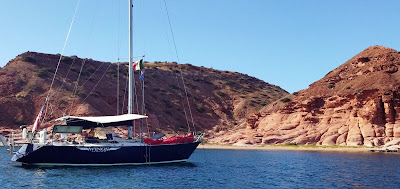 Anchored in Los Gatos
 Agua Verde
 Balandra Sand Dune
 And can we dance!
 Kids Swarming
 Judy
Judy Isla San Francisco
 Parked in Panga Highway
 Sunset in Ballandra
 Roca Solitaria
 Judy Waits Her Turn at Bache Ball
 Sailing Into Caleta Partida
 Wings Moored in Ellipse at Puerto Escondido
 Jimmy and Robin
 Judy Handles the Halyard as Fred Works Aloft
 Wings Anchored in Ballandra, Isla Carmen
 Judy Gets the Most Out of the Wind
 Puerto Escondito
 Aqua Verde
 Gigantes
 Isla San Francisco
 On top of the Mountain
 Alert
Alert.jpg)

